The Complete First-Time Pomeranian Owner Guide
From Research to Year One — Everything You Need to Know
Written from the perspective of a breeding program that lives with eleven Pomeranians every single day — everything you need before, during, and through your first year.
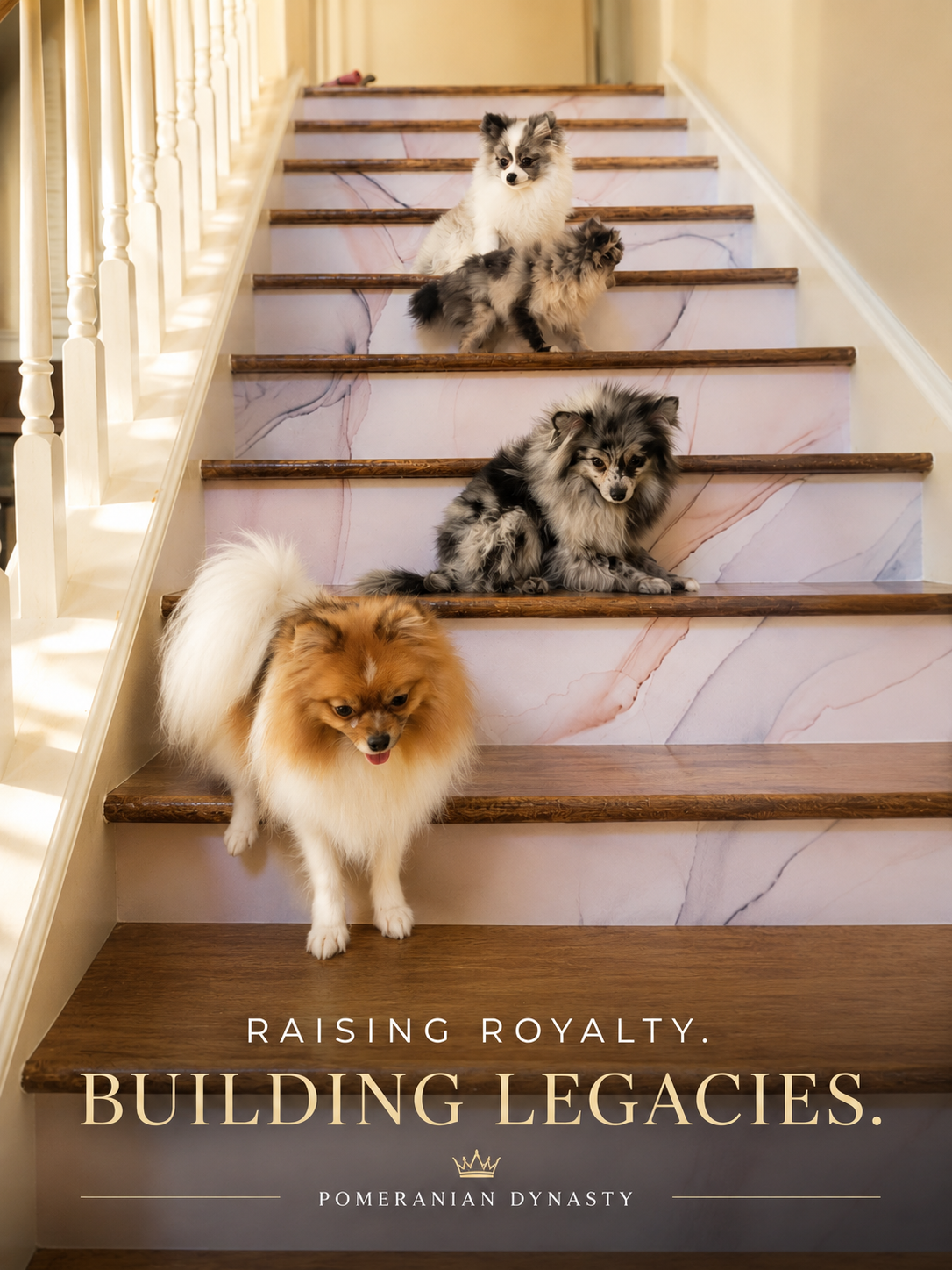
The Complete First-Time Pomeranian Owner Guide
Read the Complete Guide ↓Jump to section
- 1. Introduction — Why First-Time Pom Owners Struggle
- 2. Is a Pomeranian Right for You?
- 3. Choosing Your Pomeranian
- 4. What to Buy Before Bringing Your Pom Home
- 5. The First Week Home
- 6. Daily Care Routine
- 7. Grooming Your Pomeranian
- 8. Vet Schedule & Vaccinations
- 9. Training Basics
- 10. Socialization
- 11. Year-One Milestones
1. Introduction — Why First-Time Pom Owners Struggle
Most people fall in love with the Pomeranian look first — the fox face, the cloud of coat, the confident little strut — and only later discover that they've brought home one of the most opinionated, intelligent, and high-maintenance toy breeds in the world. That gap between expectation and reality is where nearly every first-time owner struggles. It isn't a lack of love; it's a lack of preparation.
A Pomeranian is not a small, low-effort dog. It's a full-size personality in a five-pound frame, with a double coat that needs real maintenance, a strong opinion about strangers, and a tendency to train its owner faster than the owner trains it. Poms bond intensely with their people and can become vocal, demanding, or anxious when routines are inconsistent.
This guide is written from the perspective of a breeding program that lives with eleven Pomeranians every single day. It walks the entire path — from deciding whether the breed fits your life, through choosing an ethical breeder, to the first week home, the first year of vet visits, coat care, training, and the milestones that tell you you're on track. Read it once before you commit, then keep it open through your first year.
2. Is a Pomeranian Right for You?
Temperament first. Pomeranians are alert, bold, and social with their own family, but naturally suspicious of the unfamiliar. That watchdog instinct is why they bark — not out of aggression, but out of a genuine belief that they are in charge of the perimeter. If barking is a dealbreaker in your home or building, this breed will require ongoing training rather than a one-time fix.
Lifestyle fit matters more than square footage. A Pom is perfectly happy in an apartment, but it is not happy being left alone for ten hours a day. They are companion dogs in the truest sense; isolation produces anxiety, and anxiety produces noise, chewing, and house-training regressions. Households with someone home part of the day, or with a willingness to arrange midday care, do best.
Time commitment is the number people underestimate. Budget fifteen to twenty minutes daily for coat and general care, two short walks or play sessions, and a grooming session of thirty to forty-five minutes several times a week. Add a professional groom every six to twelve weeks. Poms also live twelve to sixteen years — this is a decade-plus decision, not a season.
Finally, consider the household. Pomeranians are fragile. A three-pound puppy can be seriously injured by a jump off a couch or a misplaced step. Homes with toddlers or large, boisterous dogs can absolutely work, but only with supervision rules that everyone in the family actually follows.
3. Choosing Your Pomeranian
There are three realistic paths: an ethical breeder, a breed-specific rescue, or a shelter. Each is legitimate. A breeder gives you known lineage, health testing, early socialization, and lifetime support — which matters in a breed with predictable structural and dental concerns. Rescue gives an adult dog a second home, often with temperament already visible, which can be the better fit for calmer households.
What to look for in a breeder: they will show you the dam on site, discuss health testing and genetics openly, keep puppies until at least eight to ten weeks, provide a written health guarantee and contract, register with a recognized registry, and ask you as many questions as you ask them. Good breeders are gatekeepers, not salespeople, and they stay reachable long after the sale.
Red flags are consistent and worth memorizing. Walk away from anyone who will meet you in a parking lot instead of showing you where the dogs live, who has multiple breeds and constant availability, who pushes 'teacup' claims or promises an adult weight under three pounds, who releases puppies at six weeks, who won't provide vet records, or who accepts payment before you've had any real conversation. Pressure and secrecy are the two clearest warning signs.
When you meet the puppy, look for clear eyes, clean ears, no discharge, a sound gait with no limping or hopping, a full even coat, and a body that feels solid rather than bony or bloated. Temperament-wise, you want curiosity — a puppy who approaches, recovers quickly from a surprise, and tolerates gentle handling of paws and mouth.
4. What to Buy Before Bringing Your Pom Home
Buy everything before the puppy arrives; the first week is not the time to be shopping. Start with a small crate — roughly twenty-four inches, with a divider so it grows with the puppy. A crate that's too large defeats house training, because a puppy will simply use one end as a bathroom.
Add a playpen or gated area, because a Pom puppy should never have unsupervised access to a whole house. Get a lightweight harness rather than a collar-only setup: Pomeranians are prone to tracheal collapse, and pressure on the throat is a genuine risk. A four-to-six-foot lead is plenty; skip retractable leads while training.
For food and water, use shallow stainless or ceramic bowls — plastic harbors bacteria and can irritate the chin. Buy the same food the breeder is feeding, at least for the first two weeks, so you can transition gradually instead of triggering diarrhea during an already stressful week.
Grooming supplies are non-negotiable in this breed: a pin brush, a slicker brush, a metal greyhound comb for checking the undercoat, small blunt-nosed scissors, nail clippers or a grinder, puppy shampoo and conditioner, dog toothbrush and enzymatic toothpaste, and ear cleaner. A comb is what tells you whether you actually brushed to the skin or just fluffed the top.
Round it out with washable bedding, potty pads for the transition period, an enzymatic cleaner for accidents, a variety of textures in chew toys, a puzzle feeder for mental work, and a small carrier for vet trips. Keep a folder for vaccination records and receipts from day one.
From our kennel: buy everything before the puppy arrives — the first week is not the time to be shopping. Keep all receipts and vet records in one folder from day one.
5. The First Week Home
Expect a quiet dog for two or three days, then a personality explosion. Puppies decompress on their own timeline. Some sleep heavily and eat lightly at first; some cry at night for the litter they just left. Both are normal. What matters is that you don't respond to every sound, because the pattern you set in week one is the pattern you live with in month six.
Introduce space in layers. Start with one room containing the crate, the pen, water, and a couple of toys. Let the puppy map that space fully before opening the next room. A puppy given the whole house on day one is a puppy who will have accidents in rooms you don't check.
Set the potty rhythm immediately: outside after waking, after eating, after play, and every hour or two in between. Take the puppy to the same spot, use the same short phrase, and reward within three seconds of finishing. Accidents get cleaned with enzymatic cleaner and no scolding — a Pom that's afraid of you will simply hide the next accident.
Night one through night five, keep the crate beside your bed. Proximity reduces the panic of separation, and you can hear a genuine potty request versus a protest. Move the crate gradually if you want it elsewhere later. Also keep the first week light on visitors: the goal is safety and routine, not a social debut.
6. Daily Care Routine
Feed a Pomeranian puppy three to four small meals a day until roughly six months, then twice daily for life. Free-feeding is a mistake in this breed — it complicates house training and makes weight gain hard to see under coat. Measure portions, and weigh your dog monthly rather than eyeballing it.
Watch for hypoglycemia in young, very small puppies. Lethargy, wobbling, or glazed eyes between meals is an emergency signal; a small amount of honey or corn syrup on the gums plus an immediate call to the vet is the standard response. Consistent meal timing is the prevention.
Physically, two fifteen-to-twenty-minute walks plus indoor play is plenty for an adult. Poms are athletic but tiny; over-exercising a growing puppy stresses developing joints, and jumping from furniture is a leading cause of injury. Add ramps or steps to the couch and bed if your dog is allowed up.
Mental stimulation is where most owners under-invest. Pomeranians are among the smarter toy breeds and get destructive or vocal when bored. Rotate puzzle feeders, hide treats around a room, run five-minute training sessions two or three times a day, and teach names for toys. Ten minutes of thinking tires a Pom more than an hour of walking.
Watch for hypoglycemia in young, very small puppies — lethargy, wobbling, or glazed eyes between meals is an emergency signal. Consistent meal timing is the prevention.
7. Grooming Your Pomeranian
The double coat is the defining maintenance commitment. Brush three to four times a week at minimum, and daily during a shed or coat change. Work in sections, line-brushing from the skin outward, and finish with a metal comb to confirm you reached the undercoat. Matting starts underneath where you can't see it — behind the ears, in the armpits, around the britches, and under the tail.
Bathe every three to four weeks. More often strips coat oils; much less and the undercoat holds debris and odor. Always brush before the bath, never after only towel-drying, and blow-dry on low while brushing so the coat dries fully at the skin. A damp undercoat is how hot spots and skin infections begin.
Between eight and twelve months, most Poms go through the 'puppy uglies' — the puppy coat drops before the adult coat comes in, and the dog looks patchy and thin. It's temporary and normal. Do not shave a Pomeranian to fix it. Shaving a double coat can permanently damage regrowth and remove the insulation that protects against both heat and cold.
Professional grooming every six to twelve weeks keeps feet, sanitary areas, and the overall silhouette tidy. In between, trim nails every two to three weeks, clean ears weekly, and brush teeth several times a week — dental disease is the single most common health problem in the breed, and small mouths crowd easily.
Never shave a Pomeranian double coat. Shaving can permanently damage regrowth and removes the insulation that protects against both heat and cold.
8. Vet Schedule & Vaccinations
Book your first vet visit within seventy-two hours of bringing the puppy home, even if the breeder just had them examined. It establishes a baseline weight, confirms there are no immediate concerns, and starts the relationship you'll rely on in an emergency.
The core puppy series runs roughly every three to four weeks: DHPP (distemper, hepatitis, parvovirus, parainfluenza) at six to eight weeks, ten to twelve weeks, and fourteen to sixteen weeks, with rabies given at twelve to sixteen weeks depending on state law. Deworming typically accompanies the early visits, and fecal testing is standard.
Non-core vaccines — bordetella, leptospirosis, canine influenza, Lyme — depend on your region and lifestyle. A Pom that boards, goes to grooming salons, or visits dog-friendly patios has a different risk profile than one that doesn't. Ask your vet to recommend based on your actual routine rather than defaulting to everything.
Start monthly heartworm and flea and tick prevention as soon as your vet clears it, dosed carefully for a small body. Discuss spay or neuter timing between six and twelve months, and expect a first dental assessment around the one-year mark. Keep every record in one folder or app; you'll need it for boarding, grooming, and travel.
9. Training Basics
Potty training a toy breed takes longer than people expect, simply because the bladder is tiny. Use a fixed schedule, a single designated spot, immediate reward, and total supervision or confinement in between. Most Poms are reliable between four and six months if the schedule never wavers; inconsistency, not stubbornness, is what stretches it to a year.
Crate training is what makes house training work, and it gives your dog a place to decompress. Feed meals in the crate, toss treats inside for the dog to find, and build duration in small increments with the door closed while you stay in view. Never use the crate as punishment, and never open the door in response to barking — wait for a pause, then release.
Teach five foundations: name recognition, sit, come, leave it, and settle. Use short sessions of three to five minutes with high-value rewards. Pomeranians learn fast and get bored equally fast, so end each session while the dog is still winning.
Two breed-specific projects deserve early attention. First, barking: teach 'quiet' by rewarding the silence after an alert rather than trying to suppress the alert itself, and remove the reward of your attention when barking is attention-seeking. Second, handling: touch paws, ears, mouth, and tail daily so grooming and vet visits are boring rather than traumatic later.
From our kennel: end every training session while the dog is still winning. Pomeranians learn fast and get bored equally fast — short sessions two to three times a day beat one long one.
11. Year-One Milestones
Months two to three: the puppy settles into the home, learns its name and the potty routine, completes early vaccinations, and begins gentle handling and sound exposure. Sleep is heavy and frequent. Expect two to four accidents a day early on, trending down.
Months four to five: teething begins in earnest, so chew rotation becomes essential and nipping needs redirection rather than punishment. House training becomes largely reliable, basic commands solidify, and puppy class is ideal in this window. Adult teeth should be tracked — retained baby teeth are common in small mouths and often need removal.
Months six to eight: adolescence. Recall gets worse, testing increases, and the coat starts its awkward transition. This is where owners panic and conclude training failed; it hasn't. Hold the routine, keep sessions short, and expect the dog to come back to you mentally by nine or ten months. Spay or neuter conversations usually happen here.
Months nine to twelve: the adult coat fills in, energy stabilizes, and meals settle at twice daily. Most Poms reach full adult weight — typically three to seven pounds — between nine and twelve months, with the coat continuing to mature until two or three years. Close out year one with a full wellness exam, a dental assessment, and updated records.
Want a printable version of this guide?
Our free Starter Kit turns this guide into fillable checklists, planners, and trackers you can print or type on — shopping list, first week home, daily routine, vet tracker, grooming calendar, and budget planner.
Download the Free Starter Kit →What to Read Next
The Real Cost of Owning a Pomeranian
First-year and lifetime cost breakdown — from an active breeder raising 11.
Read →Pomeranian Color & Genetics Guide
Understand coat genetics and see what colors your pom may produce.
Read →Meet the Pomeranian Dynasty Pack
See our 11 championship-line Poms and our breeding program.
Read →
10. Socialization
The socialization window closes around sixteen weeks. Whatever a puppy learns to accept as normal in that period tends to stay normal for life, which is why an under-socialized Pom so often becomes the barking, trembling stereotype of the breed. This is the highest-leverage work you will do.
Expose deliberately and gently: different people — men, children, hats, beards, uniforms — and different surfaces like tile, grass, gravel, metal, and stairs. Add sounds: vacuum, doorbell, traffic, hair dryer, thunderstorm recordings, played quietly at first and paired with treats. Volume and intensity should always stay below the threshold where the puppy shuts down.
Before the vaccine series is complete, keep paws off high-traffic public ground. Carry the puppy through a hardware store, sit on a bench near a park, invite vaccinated adult dogs to your home, and enroll in a well-run puppy class that requires proof of vaccination. Safe exposure beats no exposure by an enormous margin.
Quality matters more than quantity. One calm, positive meeting is worth more than five overwhelming ones. If your puppy freezes, tucks its tail, or refuses treats, you've gone too far — increase distance, lower intensity, and try again another day. Keep socialization going through adolescence, because gains fade without maintenance.